"Tim Otto Roth repeatedly provoked such productive disruptions of models in various art actions, thereby illustrating that models are undermined in the real world by contingencies and human unpredictability." Martina Heßler (Sisyphos im Maschinenraum, 2025)
Natural triangular patterns It was no coincidence that in 2016, the shell of a feathered cone (Conus pennaceus) was presented like a small sculpture next to the water organ aura calcaulata. The fractal-like pattern on the shell of the sea snail grew gradually solely through the local interaction of pigment-forming cells of the mollusc – a self-organising principle that also drives the sounding and luminous activity of the organ: if line by line, the apattern corneus pennaceusctive states of the pipes are noted, similar patterns of triangles begin to emerge.
Close-up view of the shell of this Indo-Pacific snail, which is characterised by its distinctive growth patterns.
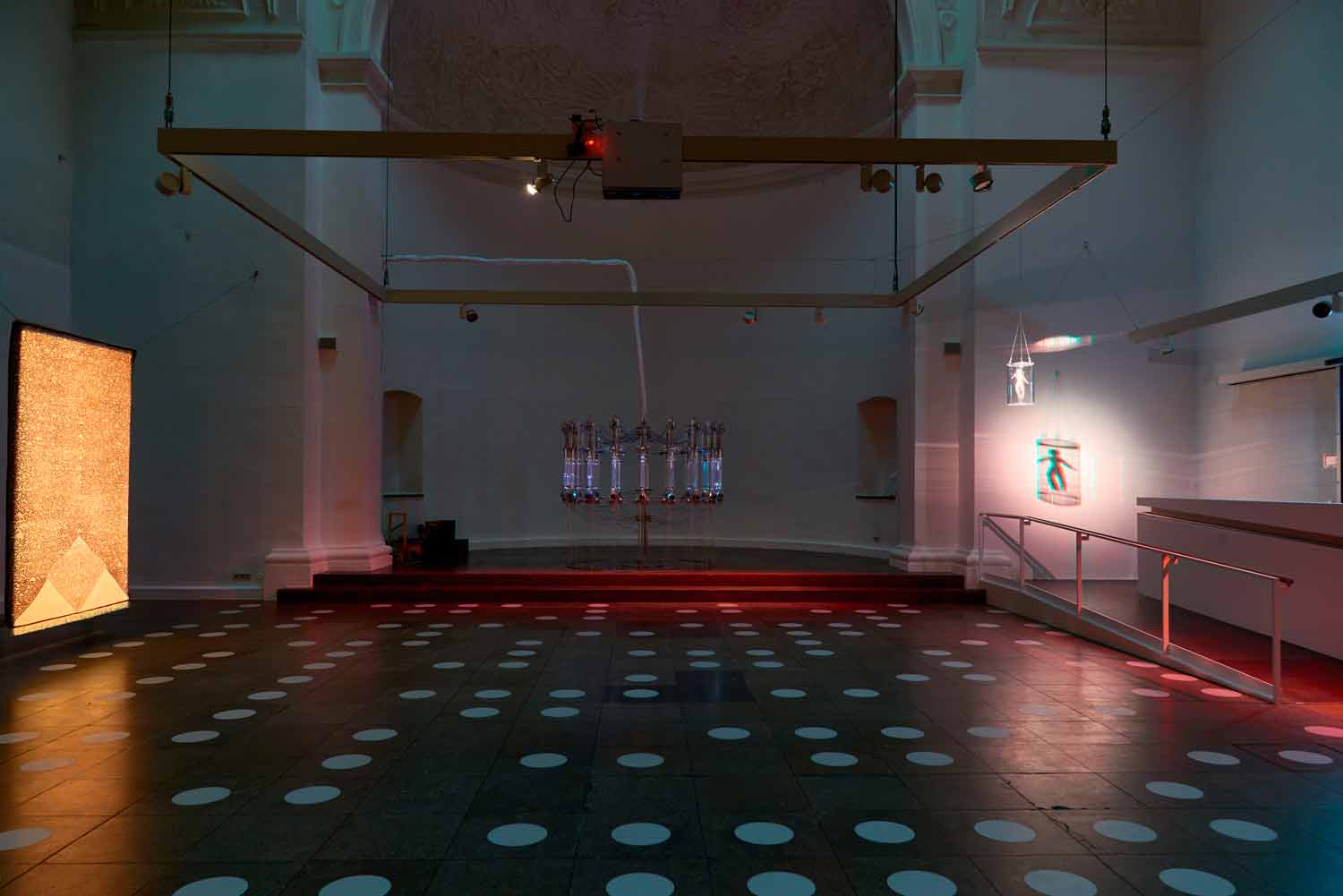
For the exhibition ‚Logical Fantasies' at the Kunsthalle Jesuitenkirche Aschaffenburg, the activity pattern was transferred to the floor tiles of the nave as a large floor ornament.
Cellular automata Researchers have been exploring these principles of self-organisation for quite some time to model complex processes such as the formation of fur, scale or skin patterns in animals, traffic flow behaviour in traffic jams, or the growth of tumour cells. A special model was conceived in the late 1940s by mathematician John von Neumann and physicist Stanislav Ulam: These so-called cellular automata can be imagined as a simple scenario, such as a string of pearls. Each bead functions like a small 'iterative computer' (John Holland) that analyses the states of its neighbours in discrete time steps. Based on a specific rule that is identical for all beads, they derive their own new state. From nothing, this simple form of feedback can cause triangular patterns to grow, similar to those found in spring cones.
The rule derived from the 'Mexican wave' in stadiums drives the circularly closed bead chain on the left. If the rule is modified so that a bead is active when either its left or right neighbour is active, a different pattern emerges (on the right and floor lamps in the background). This additive rule is also used in the loudspeaker installation in Dresden.
Calculating Space Applying this principle to a surface creates 'tesselated structures' (Edward F. Moore), whose topology (triangles, squares, hexagons etc.) and the associated definition of neighbourhood significantly influence the behaviour of these systems. Game theorist John Horton Conway experimented with a square tiling, developing his famous Game of Life on a giant chessboard without the use of a computer. However, the idea can be taken even further into higher dimensions: the automata also inspired Konrad Zuse – the inventor of the first functional computer – to come up with the idea of a physical 'Calculating Space'.
From hydraulic organ to scientific paper Using a sophisticated analytical process, Tim Otto Roth brings such a 'calculating space' into sound in his own unique way. What is new about this artistic exploration of automata is that the conceptual artist and composer undertakes a systematic long-term observation of local dynamics. As each individual unit observes and evaluates separately its own states in the most recent steps, these temporary attractors can be used to evaluate the dynamic development of a system over a longer period of time. In this way, the changing water levels in the organ, for example, not only create music that is genuine to the automata. Roth has also succeeded in deriving an analysis from this that differs from previous scientific classifications – an achievement that has been recognised, among other things, by a peer-reviewed publication in the renowned journal Physika D.
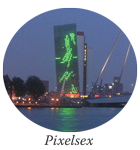
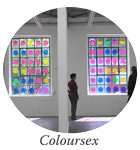
Pixelsex & Mathematical Socialism Roth has been fascinated by automata as a minimalist form of networks for over two decades. He has repeatedly explored the various facets of automata in collaboration with scientists, in particular with biomathematician Prof. Andreas Deutsch, with whom he initiated, among other projects, the PiXL choir at the Technical University of Dresden. His working group had already supported him in 2005 with the project Pixelsex at the KPN Telecom Tower in Rotterdam. Project titles such as Pixelsex, but also Mathematical Socialism, are part of Roth's artistic redefinition of cellular automata: Pixelsex expresses the idea that discrete units are engaged in a local exchange from which a product can potentially emerge. Roth first used the term Mathematical Socialism for an exhibition at the Goethe Institute in Hanoi in 2017 as a critical response to state-imposed socialism and the censorship of artistic production. The name refers to the fact that in a system of discrete units, all of which have the same prerequisites and operate according to the same rules, neither a uniform pattern nor chaos necessarily emerges. Within the narrow limits of prescribed behaviour, unexpected diversity can develop despite standardisation.
Tim Otto Roth: About the robustness of 1d cellular automata revising their temporal entropy, in: Physica D: Nonlinear Phenomena Volume 425, November 2021.
Tim Otto Roth: The Charme of the Discrete Error – When Mathematical Socialism Becomes Art, Journal of Cellular Automata, 16.1-2, 2021, p. 153-171.