
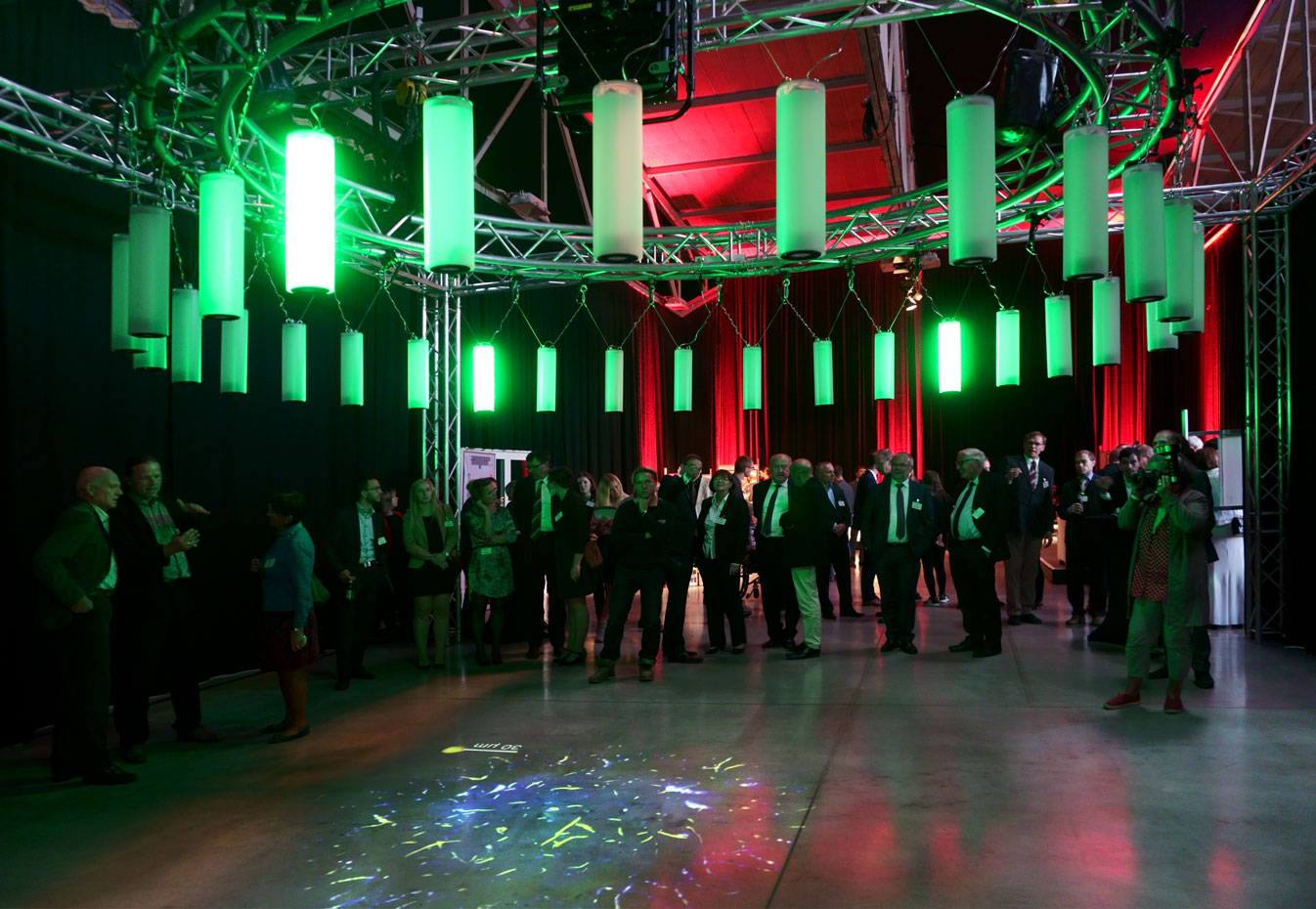
Aura goes nano In the darkened space of the Studio 5 at IRCAM/Centre Pompidou a ring of 30 illuminated loudspeakers is pending from the ceiling. They are playing variations of band-filtered noise, which can sound like a soft blow of wind or the terrifying sibilance of a summer thunder storm. The driving force of the activity of the tubular translucent loudspeakers designed by the imachination labs is an automaton like self-organisation on a sub-sub-mircobiological level.
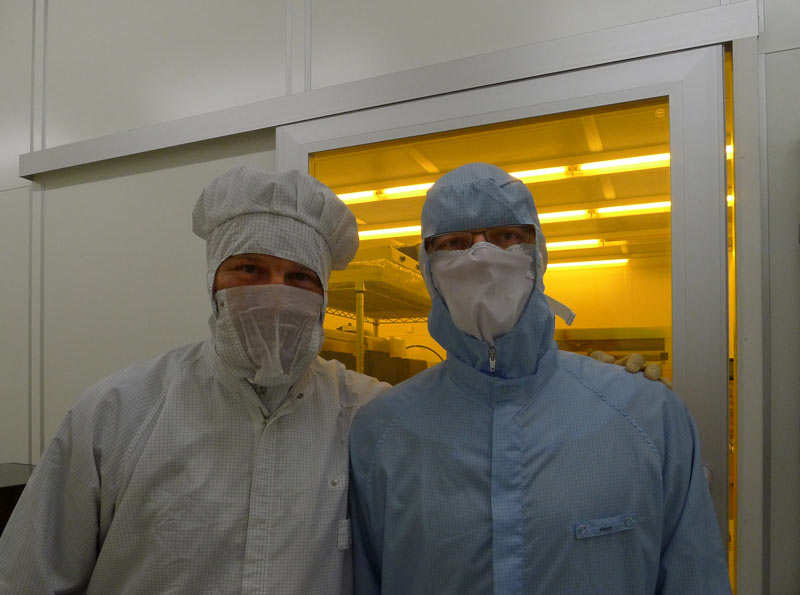
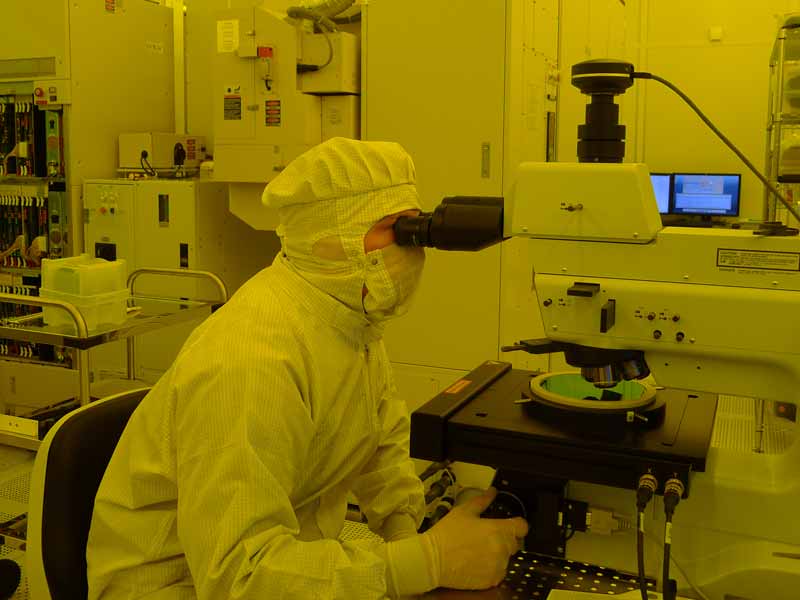
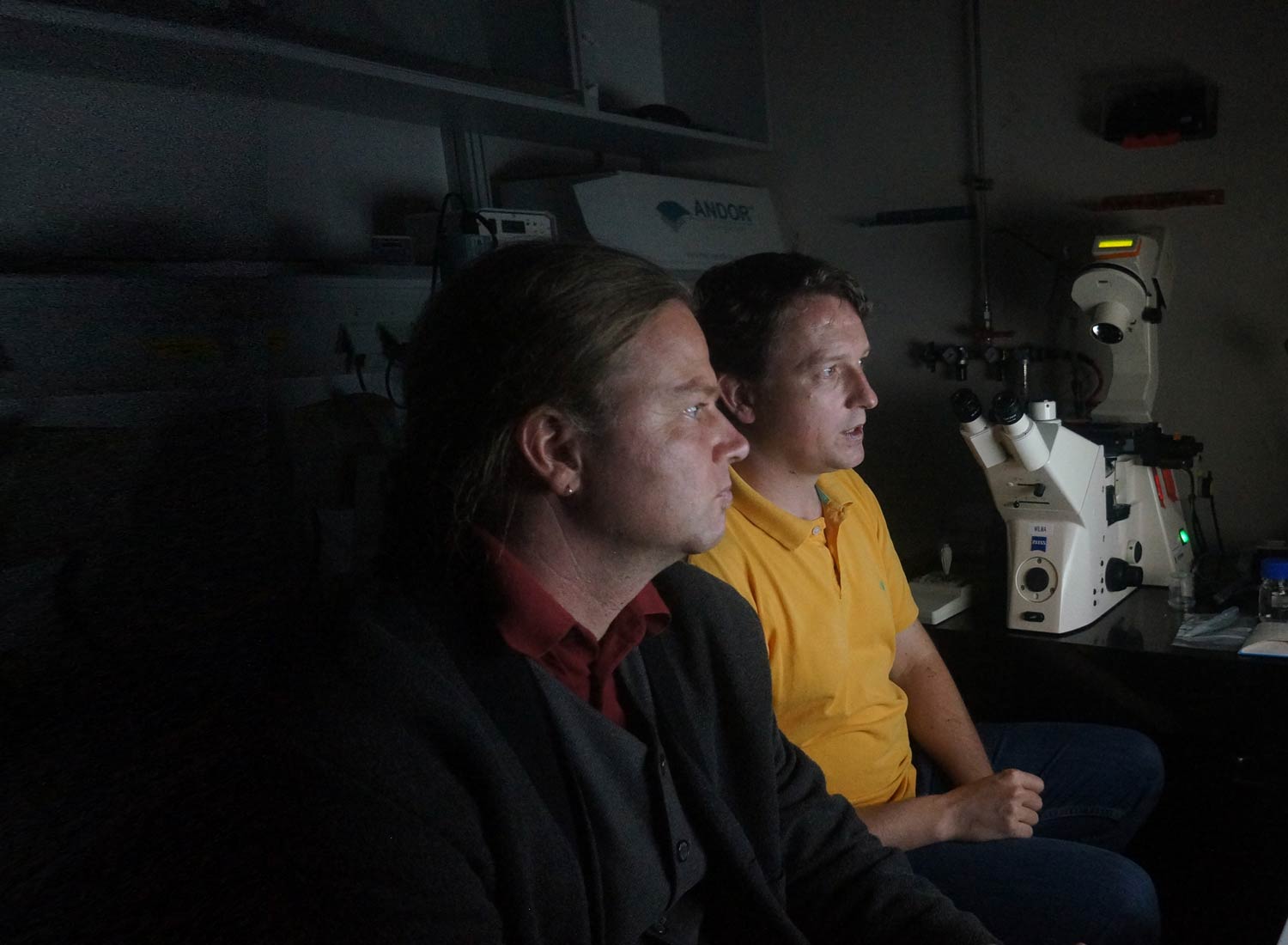
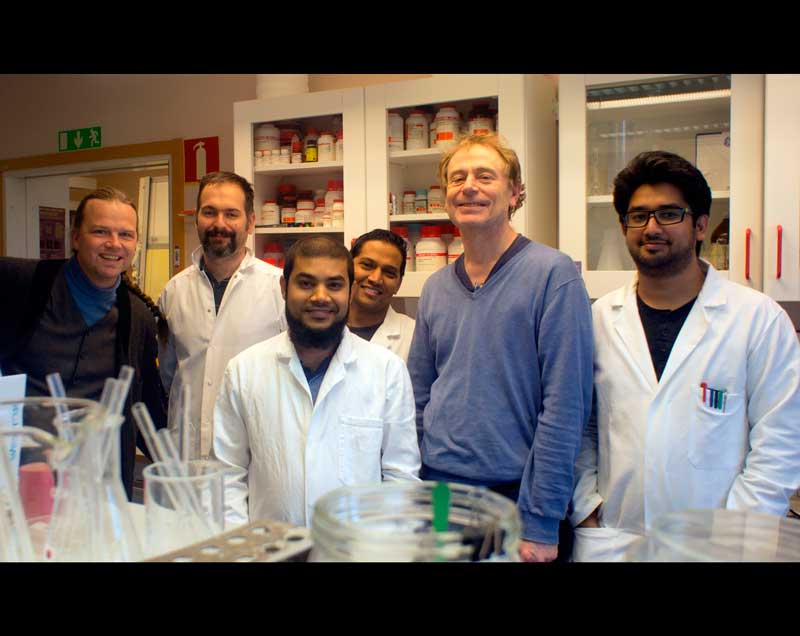
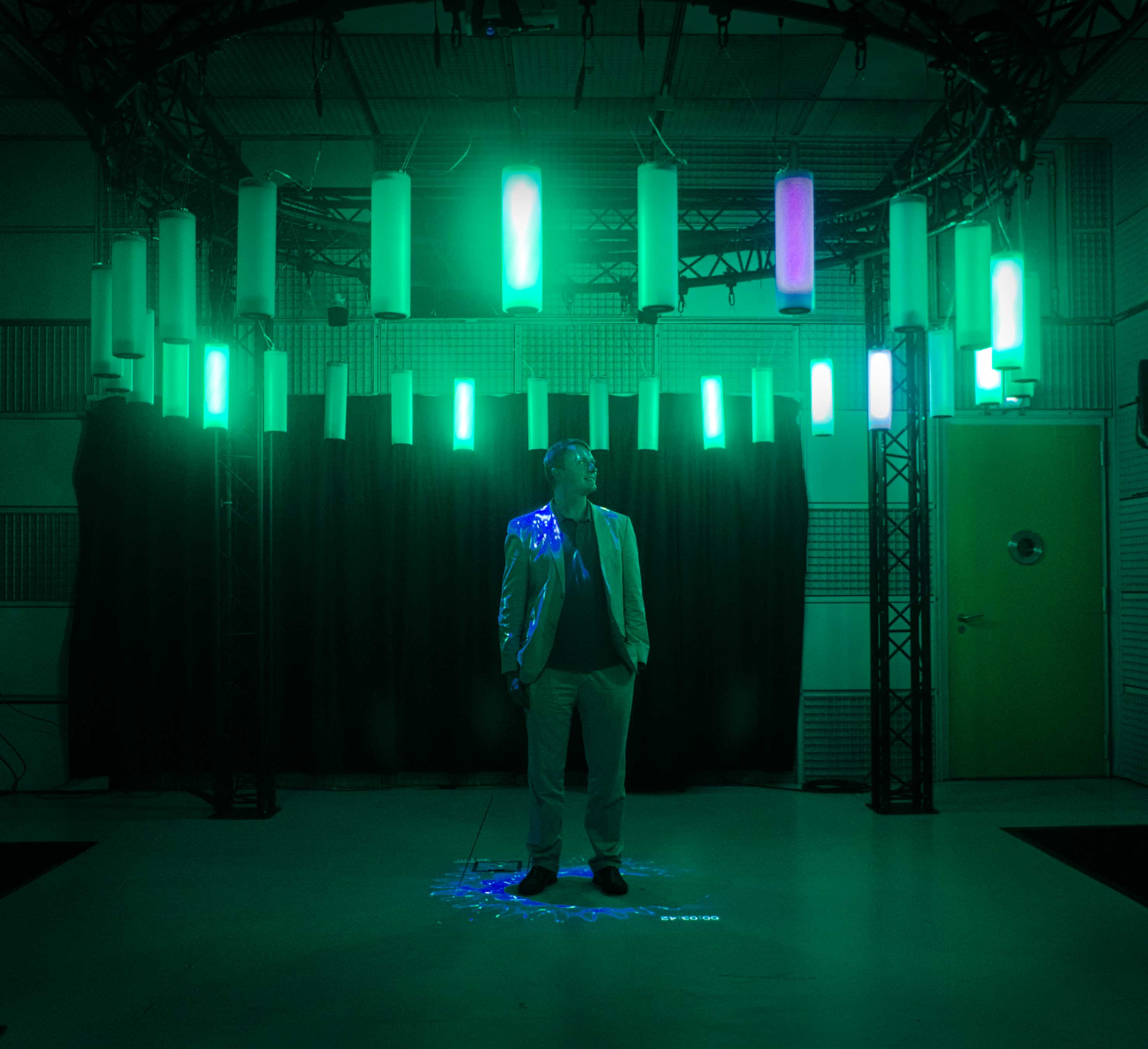
Biomolecule as computers The key to the work entitled SMART>SOS is a floor projection in the middle of the speakers showing an animated series of fluorescence microscope images depicting worm like agents travelling trough channels of an ornamental circular nano-structure. The organic forms meandering in the valley structure edged in to Silicon-dioxide are not organisms but at a much smaller fundamental structure of the cell skeleton – the so called microtubules measuring. Like stage divers these tube like protein polymers are gliding over the heads of motor molecules which make them move in this specialnano-structure, which Tim Otto Roth designed during his STArts Residency (Horizon 2020) with Bio4Comp researchers in Dresden, Chemnitz and Sweden.

Logic by interaction The challenge of the SMART>SOS project was to modify the Bio4Comp circuit design by adding feedback to the network structure of split and cross joints to create a kind of rudimentary logic gate by temporarily blocking a channel. The result was a kind of smoothed saw blade structure serving as reservoir to feed in agents to the outer ring like logic structure with 30 ‚gates'. The flux at these gates finally was represented by the light and sound play of the speakers. This installation was a caesura also in Roth's compositorial work experimenting for the first time with filtered noise.
ⓘ 30 sound pixels (each approx 12 x 40cm), microelektronics (ESP32), speaker chassis, acrylic and polycarbonat glas, led, cable, 24V DC power supply system (1000 W), two control computers, ca. 4 x 4 x 3.2 m.
Hilberts (T)raum (2024) Considerations on how quantum systems could be linked to the self-organising principle of cellular automata have been raised time and again, including by Nobel Prize winner in Physics Anton Zeilinger (2008). In 'Hilberts Traum' (en. Hilbert's Dream), superposition, a central element of quantum systems, is musically linked to cellular automata. In this dream calculation, one is immersed in a quantum-extended development of such a computing space (Konrad Zuse 1967), in which not only does the classical automaton resound, but it is also dynamically contrasted by a possible pair of superposition states.

Prime number 29 It is no coincidence that 29 loudspeakers are used, arranged in a 14-metre-long row across the entire hall, creating a completely different listening experience to that of a circular arrangement. With the prime number 29, the underlying cellular automaton makes a combinatorial leap for the selected rule – only after 16,383 iterations does the combination of on and off states repeat itself. As with the other aura calculata works, the cells all start playing the same tone, but gradually the pitches shift with the attractors – in different ways for the superimposed 'base automata' and the actual automaton. Roth has composed varying modes with sometimes dramatic tempo fluctuations to accentuate these three activities sonically. Different microtonal scales are used, such as an equal 29-tone scale or the Indian shruti scale, which divides the octave into 22 unequal intervals, resulting in special overtone overlays.
ⓘ 29 sound pixel (each approx 12 x 40cm), microelectronics (ESP32), speaker chassis, acrylic and polycarbonat glas, led, steel wire, cable, 24V DC power supply system (1000 W), control computer, total length approx. 14 m.
Learn more on the project page SMART>SOS.